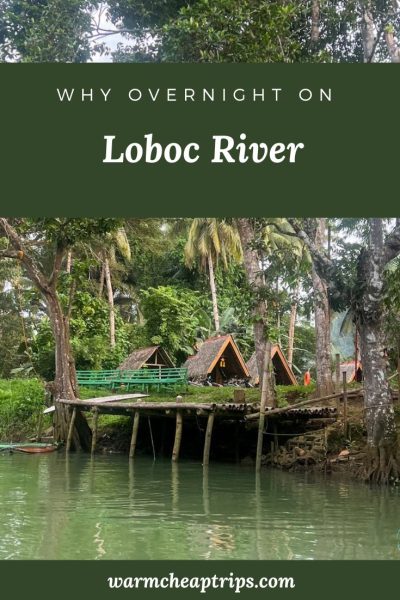


It was at the Loboc River that I experienced one of my most moving moments in the Philippines—one of those moments where a sense of peace washes over you and you feel deeply connected to nature. If there is one thing you absolutely must not miss in Bohol, it is spending at least one night on the riverbanks, ideally at the Water to Forest Ecolodge.
The Loboc River is a placid waterway surrounded by lush vegetation, and it is a must-see in Bohol along with the Chocolate Hills and the Tarsier Sanctuary. Usually, travelers stay in Panglao to be closer to the white sandy beaches, visiting the Loboc River only as a day trip on mini-cruises with a local lunch buffet on board.
However, I suggest you plan for a night on Bohol island before heading to the relaxation of Panglao. Choose to stay right on the banks of this river; this way, you’ll have the chance to join an evening firefly tour—and who knows, with a bit of luck, a firefly might even fly right over your bed, just as it happened to me.
By now, spending at least one night in nature-based accommodations has become a “must” for my trips—ever since that incredible experience with the elephants at the Chai Lai Orchid in Chiang Mai. I thought nothing would ever match the emotion I felt in the floating house in Halong Bay, but here too, amidst Bohol’s lush greenery and the slow flow of the Loboc River, I experienced moments I will never forget.
There are several eco-resorts along the river, and I am sure they all offer a wonderful experience in nature, some with more and some with fewer comforts, such as air conditioning or private bathrooms. Personally, I love the most authentic experiences possible, even if they almost always involve shared bathrooms and only a fan. Generally, these places don’t have many rooms, which allows you to fully enjoy the experience, offering peaceful evenings and opportunities to socialize with the staff and other guests during the day. For this reason, my final choice was the Water to Forest Ecolodge, and I couldn’t be more satisfied.

River Cruise vs. Overnight on the Loboc River
The Loboc River cruise is one of the most recommended activities in Bohol and is certainly a beautiful experience: you sail down this peaceful basin admiring the surrounding jungle and the villages along the banks, while enjoying a delicious buffet of Filipino dishes and watching performances of local songs and dances.
Since the river is vital to Bohol’s entire ecosystem—home to many aquatic species and with the surrounding forest acting as a natural habitat for many animals—all the restaurant boats are environmentally conscious. In fact, I found a good level of environmental awareness and waste management in Bohol, much more noticeable than at the beaches of nearby Panglao, for example.
The entertainment provided by the locals, featuring typical songs and dances from the area, is also a great example of how local traditions are preserved and passed down. Since the Philippines is made up of so many islands, each with its own language and culture, it’s wonderful to discover the different local versions.
The cruise is also an excellent way to see the Loboc River while optimizing your time, as you have lunch on board (boats depart every 30 minutes from 10:30 AM to 2:30 PM and the tour lasts one hour), allowing you to continue your day by visiting the Chocolate Hills and the Tarsier Sanctuary.
The cost is around 1,000 pesos. You can book independently by going there (in low season) or via Facebook if you have a scooter. Alternatively, you can join an “inland tour” offered almost everywhere, though I recommend booking through GetYourGuide (by downloading the app and using the code WARMCHEAPTRIPS5 you will get a 5% discount) to avoid the unpleasant setbacks that are unfortunately frequent with tours bought from vendors at Alona Beach (I’m speaking from experience!).
While the cruise is still a nice experience, your time is quite limited and you will be sharing the river with many other people, making it a bit more chaotic and detracting from the sense of peace and tranquility that this river offers.
By choosing to stay at an ecolodge, you will truly have the chance to connect with nature, unplug, and recharge your energy—which is vital for our balance and well-being, especially in today’s world that demands we always be hyper-connected and super active.
It’s not just about relaxation, but also the chance to discover the river and its banks at a slower pace—renting a SUP or a kayak and walking through small local villages, truly immersing yourself in the magic of the Philippines, far from mass tourism and organized groups.
My Unforgettable Experience at Water to Forest Ecolodge
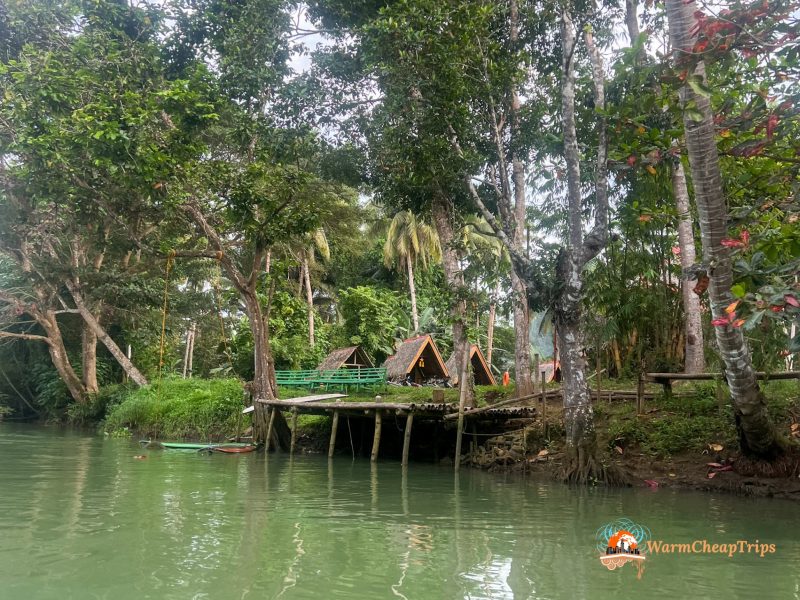
The Water to Forest Ecolodge is located at the end of a dirt road, beyond a small village of modest houses, surrounded by greenery and featuring a small wooden terrace right on the river.
As soon as I arrive, I feel a sense of peace entering my chest, and all the exhaustion of a very long day that started at 4:00 AM vanishes in an instant. I feel recharged and relaxed; the Wi-Fi password is surprisingly the last thing on my mind, even though the connection barely reaches the room.
After receiving some simple information (no lights or noise after 9:30 PM, do not leave open food in the rooms, make sure to close the mosquito net properly, etc.), we take our bags to our “room” and immediately walk along the small wooden path to the river terrace.
Sitting with our feet dangling, we watch the slow flow of the water and the silent coming and going of kayaks, SUPs, and local boats gliding by. Later, we too will be among those navigators… a sunset kayak trip awaits us, before paddling into the darkness in search of fireflies.
I don’t know how long we spent there, listening to the sounds of nature around us, feeling grateful for the moment I decided to skip a night at the beach to spend it here—right before December 31st, when we will be waiting for the New Year amidst the crowds and parties of Alona Beach.
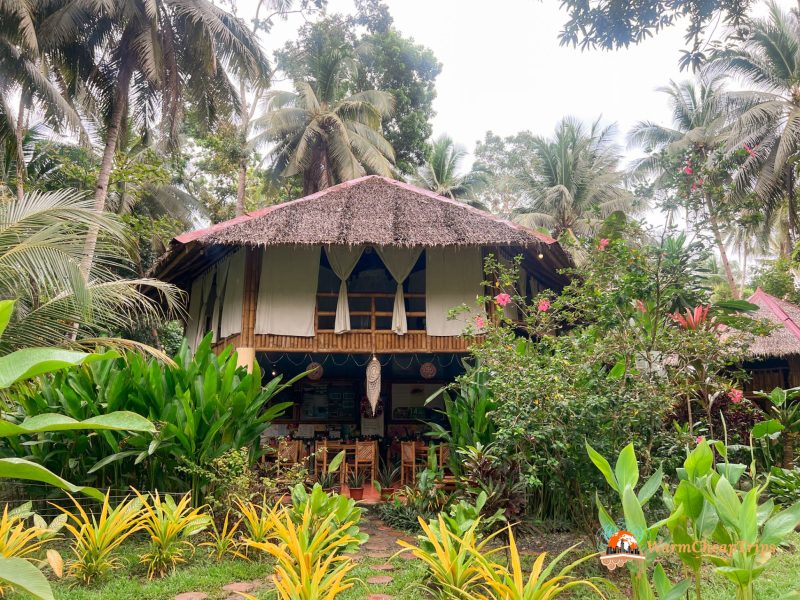
The ecolodge buildings are made of wood and bamboo, with a central structure where you’ll find the reception and a small café-restaurant on the ground floor, offering a good selection of simple, tasty, and generous Filipino dishes. On the upper floor is the dormitory, with single and double beds separated by heavy curtains for privacy, all protected by mosquito nets hanging from the ceiling and directly overlooking the beautiful surrounding nature.
There are also two private cabins, with the bed on the upper floor and a small hammock to curl up in with a book on the ground floor. I would have loved to stay in one of these, but unfortunately, they were already fully booked.
The bathroom is shared, with two showers, two toilets, and two sinks in an external wooden structure with hot water and good pressure. Everything is very clean and stocked with soap, while towels are provided in the room.
Staying here is a beautiful experience in itself, but it’s made even better by the possibility of renting SUPs and kayaks independently or joining the evening firefly tour.
We opted for the “extended version,” lasting nearly 3 hours for 1.100 pesos on single kayak or 1.900 pesos for double kayak, which includes watching the sunset from the river before paddling at twilight to reach spots on the Loboc River where a high concentration of fireflies gathers.
Paddling in the dark, surrounded by the sounds of the forest, is already something magical. But when you find the dancing fireflies before your eyes in the darkness—like a Christmas tree with natural lights—while being cradled by the slow current of the river, that’s when the emotion hits you, and your eyes well up.
After a while, the magic was unfortunately interrupted by the engine of the night cruise boats that carry tourists to see the fireflies without any effort. However, the fireflies are even more disturbed than I am by this sudden crowding and noise; over time, they might disappear from this area, just as they have from much of our countryside. Being a responsible tourist means, above all, leaving as little trace as possible of your passage. I invite you to make a conscious choice and boycott these night cruises in favor of a much quieter kayak excursion.

Staying on the Loboc River also means consciously choosing a different way to travel: slower, quieter, and more respectful. It’s about discovering the most intimate and authentic side of Bohol—the kind that stays with you long after you return, one of those memories of the Philippines that you will carry in your heart.
Planning a trip to the Philippines? Read Also:
– Palawan itinerary
–Where to stay at El Nido
And don’t forget the travel insurance, with Heymondo you have the 5% disciunt as my reader