


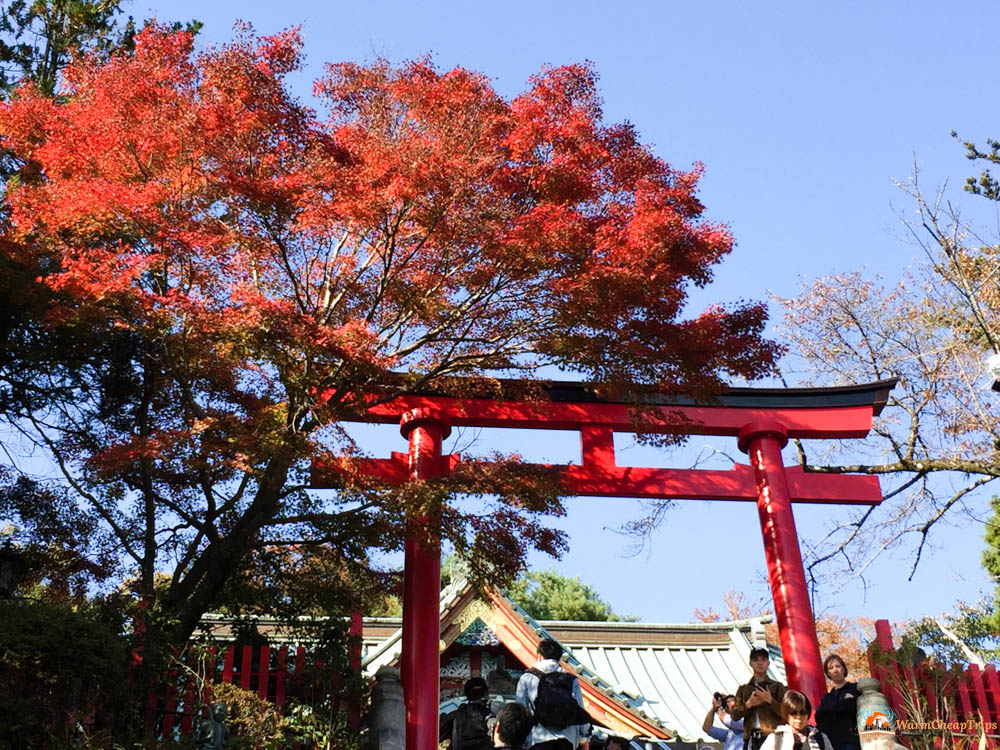
Autumn in Japan is truly wonderful. The vibrant red of the Momiji (maple leaves) colors the forests with fiery tones, creating a stunning contrast with the delicate pink of the spring Sakura. While spring marks a new beginning—a slow awakening from the neutral white of winter—autumn is the last glowing spark that warms the soul. In Tokyo, the foliage and its warm hues arrive in mid-November, later than in Europe or North America. So, if you are planning a trip to Japan to see the Momiji, remember to travel during the month of November.
Mount Takao, located within the Tokyo Prefecture just an hour by train from Shinjuku, is one of the best places to witness the Japanese foliage. It is also a fantastic nature excursion that can be enjoyed year-round.
Takaosan—as this mountain is honorifically called (actually a hill, as it doesn’t reach 600 meters)—is the perfect day trip for those wanting to immerse themselves not only in nature but also in Japanese spirituality. It is said that the Tengu live here: powerful mythological figures and protectors of the mountains.
Although it feels worlds away from the central districts of Tokyo, Mount Takao is effectively part of the Tokyo Metropolitan area. This makes it very popular among locals for weekend trips, often crowding the main trail and the summit, especially during the koyo (autumn colors) season. If possible, plan your visit on a weekday.
Mount Takao is also a sacred mountain, and the reading of the kanji for “mountain” 山 here is not yama but san, just like Mount Fuji. This is also where Yakuōin Temple is located, an important pilgrimage site built by Emperor Shōmu in 744. In this Shinto-Buddhist temple, Tengu is also worshipped—a long-nosed figure said to bring good fortune.
Hiking Mount Takao
Upon exiting Takaosanguchi Station, you will find a large map showing all the trails leading to the summit. A 500-meter walk from the station leads to the main plaza where the cable car and chairlift depart. Here, you can find free maps in English. The area is filled with restaurants, souvenir shops, and local sweets—also available near the temple and at the summit.
There are seven main trails on Takaosan. Only three start from the main plaza; the others intersect later near the top of the cable car station. If you want to enjoy the colors comfortably, the cable car or chairlift are great options.
At the summit, you’ll find restrooms, shops, and many benches. However, I recommend bringing a picnic blanket to spread under the maple trees. On clear days, especially in winter, you can enjoy a breathtaking view of Mount Fuji.

Trail No. 1
This is the most popular trail, as it is very wide and paved, making it suitable even for strollers and elderly visitors. In a couple of places there are small steps—very low and wide ones—that are easy to manage. There is one staircase, but it is also possible to take a slightly longer route and reach the top of the small hill via a path without steps. Trail 1 connects with the arrival points of the cable car and chairlift, and along the way you’ll also find the terrace that hosts the beer garden in summer, as well as the Monkey Park (natural monkey zoo, entrance ¥420). The Yakuōin Temple complex is also located along this trail, which then continues without difficulty all the way to the summit.
Total length: approx. 3.8 km – about 100 minutes uphill, 80 minutes downhill.
Trail No. 2
This is a loop trail that runs around the Monkey Park through a quiet forest. It is not very busy, but it makes for a lovely walk in the woods. I walked part of it because it also connects Trail 6 with Trail 1. Along this path there is a very evocative section lined with Jizō statues, the protective figures of unborn children.
Total length: approx. 0.9 km – about 30 minutes.
Trail No. 3
Trail number 3 runs alongside the Yakuōin Temple (which can also be reached via other paths) and leads to the summit of Mount Takao, passing through the forest and over a wooden bridge above a stream. It is not very crowded and in some sections it is a bit steep, with tree roots crossing the path. I walked part of it as part of my “alternative route” and I must admit it is the most physically demanding trail to tackle.
Total length: approx. 2.4 km – about 60 minutes uphill, 50 minutes downhill.
Trail No. 4
Just before entering the temple complex, on the right-hand side, you’ll find the start of Trail number 4. It’s a beautiful route with interesting scenery, where you can see the changing autumn colors, and it crosses a striking suspension bridge immersed in vegetation. I had initially ruled it out with some regret, but after finding a connecting path I managed to explore this one as well and cross that lovely little bridge!!
Length: approx. 1.5 km – about 50 minutes uphill, 40 minutes downhill.

Trail No. 5
Another loop trail, running just below the summit of Mount Takao. In spring, you can admire various types of flowers along the way.
Total length: approx. 0.9 km – about 30 minutes.
Trail No. 6
This trail is also very charming and is the second most popular one. It starts from the initial plaza near the station and follows a small stream, which must be crossed at one point along the route. You also pass by Biwa Waterfall, where it is sometimes possible to see ascetics engaged in meditation. I began my ascent of Mount Takao on this trail and, once I reached the waterfall, instead of continuing straight on I followed the signs for Trail 1, crossing Trails 2 and 3 up to the entrance of the temple complex, from where I was able to take Trail 4.
Total length: approx. 3.3 km – about 90 minutes uphill, 60 minutes downhill.
Inariyama Trail
The Inariyama Trail follows a completely different route and intersects with Trail 6 only near the summit of Mount Takao. This trail offers different landscapes depending on the season, and about halfway along there is a panoramic viewpoint.
Total length: approx. 3.2 km – about 90 minutes uphill, 60 minutes downhill.
I’ve been to Mount Takao three times, trying out different combinations of trails.
The first time, my initial idea was to hike up to the summit of Mount Takao via Trail No. 6 and then come back down via Trail No. 1. Luckily, at the waterfall I found a clearly marked connecting path that allowed me to reach the intersection with Trail No. 4 and also see the suspension bridge, so I definitely recommend this option to you as well. Taking into account a couple of snack breaks, lots of photo stops, and some slowdowns due to crowded sections, it took me about two and a half hours in total.
For the descent, I chose to follow Trail No. 1 in order to visit Yakuōin Temple.
The second time, I did both the ascent and the descent via Trail No. 1, which I don’t recommend, especially for the uphill section. Yes, it’s the most accessible route because it’s completely paved, but that also means a constant incline that really puts your back to the test. Personally, I prefer a more “rugged” trail, but with more variation in gradient and terrain.
The third time, I went up by cable car, which has a very steep gradient (the steepest in Japan!), especially in the final section, and passes through stunning, fiery-red maple trees. Keep in mind, however, that on weekends there is often a queue of over an hour to take it.
On the way back down, I took the Inariyama Trail and really loved it, especially for the variety of landscapes and plants you encounter along the way. It’s also much less crowded than the other trails and truly lets you enjoy the walk. I wouldn’t recommend doing it uphill, though, unless you’re very fit.
Price for both the cable car and the chairlift: ¥490 one way – ¥950 round trip.
Yakuoin Temple
Mount Takao is a sacred place, linked to the tengu, and here is also the Yakuoin temple complex, which houses several buildings. In the first part, there is the Buddhist temple, while climbing the staircase you encounter the Shinto gate and the corresponding buildings. In the area not accessible to the public, ascetics still live today. Several Tengu statues adorn the path leading to the temple and many faithful come here to pray to the mountain deities to request good luck, health, or success in business. At the Yakuoin temple, it is also possible to try some traditional experiences, such as dining with traditional Buddhist vegan cuisine (Shojin Ryori), or attending the fire ceremony: an emotional purification ceremony in which a purifying fire is lit and the monks chant sutras accompanied by taiko (drums) and horagai (a sort of large conch in which one blows). The first Saturday of the month and some other fixed days, it is also possible to try the experience of ascetic training: Zen meditation, reading of sutras, waterfall asceticism. All these experiences require advance booking; more information on the temple website.

Keio Takaosan Onsen Gokurakuyu
Once back at Takaosanguchi station, I recommend relaxing your muscles and recovering from the walk in the beautiful onsen located right behind the station. On weekends it might be a bit crowded and you might have to wait about fifteen minutes before being able to access the structure. Entry costs 1300 yen (small or large towel rental 150 yen) and tattoos are not allowed. Shoe lockers, lockers for personal items, shower sets, and hair dryers are available.
There is an indoor “special bath” tub that changes from time to time (it was pink when I was there), a semi-outdoor one with a milk bath, three outdoor tubs of 38-39-41°C overlooked by momiji, and 4 outdoor seats for the foot bath. There is also a sauna and a cold water tub.
Like every onsen, the tubs are separated by gender and no swimsuits are worn.
In the common areas, there is a restaurant, a rest room, a vending machine corner, and it is possible to book a relaxing massage.
I must say that after the walk, a nice relaxing onsen feels really good, and soaking in hot water watching the momiji is the perfect conclusion to a day away from the city chaos.

How to get to Takaosan

From Shinjuku, take the Keio Line to the last stop Takaosanguchi, duration just under an hour with rapid train, 430 yen.
It is also possible to take the JR Chuo Line to Takao Station, and from there take the Keio Line which in a couple of minutes leads to Takaosanguchi (otherwise it is two kilometers on foot).
Did you find this article useful? Buy me a coffee 🙂

