


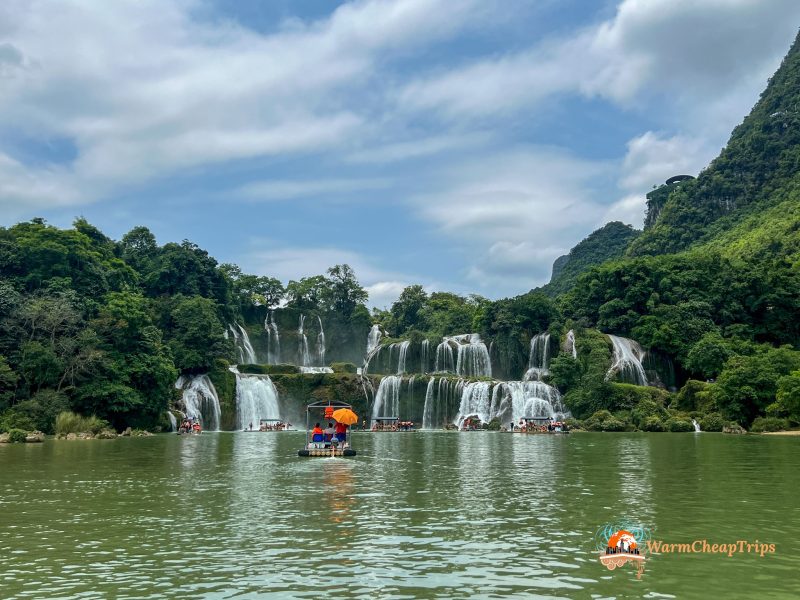
While planning my northern Vietnam itinerary and searching for unique, lesser-known places, I came across stunning images of the Ban Gioc Waterfalls, located right on the border with China. The fourth-largest transnational waterfalls in the world and among the most impressive in Southeast Asia, they remain a peaceful destination largely untouched by mass tourism — mainly thanks to their rather remote location.
Ban Gioc Waterfalls are about a 6-hour drive from Hanoi (280 km), and the nearest town, Cao Bang, lies more than 80 km away. This is a rural and fairly remote area in northeastern Vietnam, right on the Chinese border, within the Non Nuoc Cao Bang Geopark, a UNESCO Global Geopark.
Despite the difficulty of finding clear information online about how to get there, the idea of standing in front of what many describe as the most beautiful waterfalls in Indochina (some even said “as stunning as Niagara Falls or Iguazú Falls“) fascinated me so much that I decided to include this stop in my itinerary.
Honestly though, after visiting them, I have to admit that while they are indeed beautiful, they fell slightly below my expectations. Given the grand descriptions I had read in the few articles available online, I imagined something far more majestic and dramatic. Unfortunately, this was something I experienced more than once during my trip to Vietnam.
Part of the reason may be that I chose to visit using public transportation from Cao Bang. While this option offered a wonderful glimpse into local life and was incredibly budget-friendly, it ultimately wasn’t the best decision, as it prevented me from exploring the other natural attractions in the area. In fact, this is one part of my itinerary I would definitely organize differently if I could go back.
Visiting Ban Gioc Waterfalls
Ban Gioc Waterfalls sit directly on the border between Vietnam and China and can technically be visited from both sides.
The Vietnamese side is flat and located at the base of the falls, while the Chinese side appears to offer a path climbing up the hillside, providing a more panoramic view of the entire waterfall system.
I understood that there have been pilot projects aimed at allowing cross-border visits between the two sides, but neither at the time of my visit nor now have I found reliable information confirming this. For the moment, visitors arriving from Vietnam can only access the Vietnamese side.
DON’T FORGET:
→ Travel insurance: HeyMondo 5% OFF
→ eSIM Airalo: 3$ OFF on your first SIM with the code MICHEL5108
or 10% off with the code AIRALOESIM10 if already a client
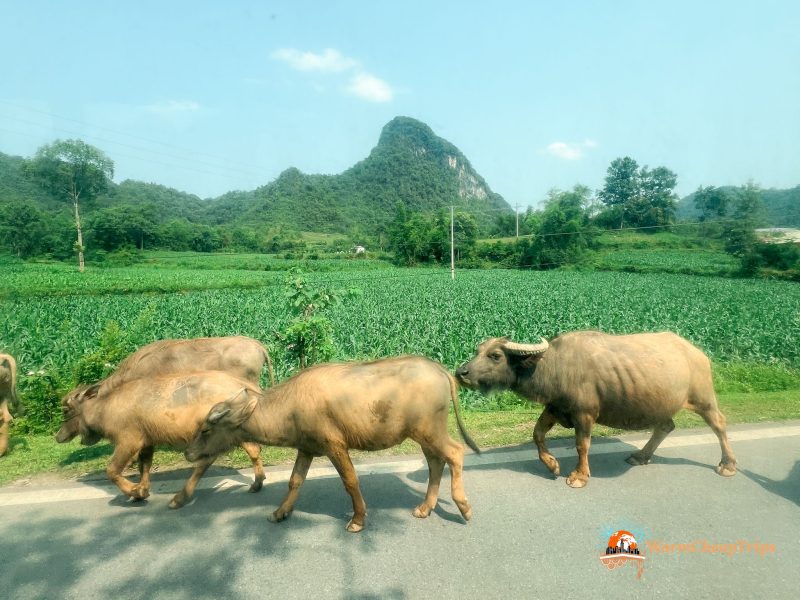
After passing through beautiful landscapes of lush green hills rising above rice fields, you reach a small area near the waterfall entrance. A few souvenir stalls and simple eateries surround the parking area where the ticket office is located. The entrance fee is 50,000 VND, and a pleasant pathway lined with plants, flowers, and benches quickly leads — after the first curve — to the first view of the waterfalls.
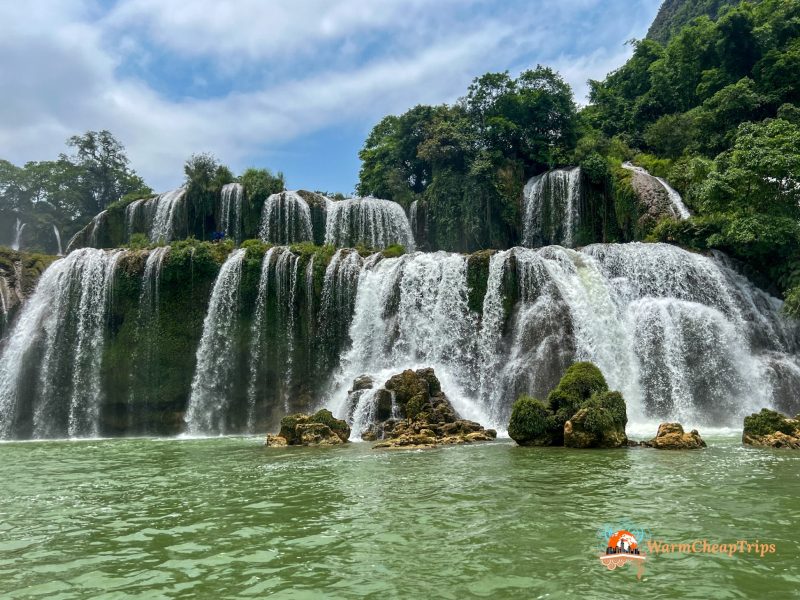
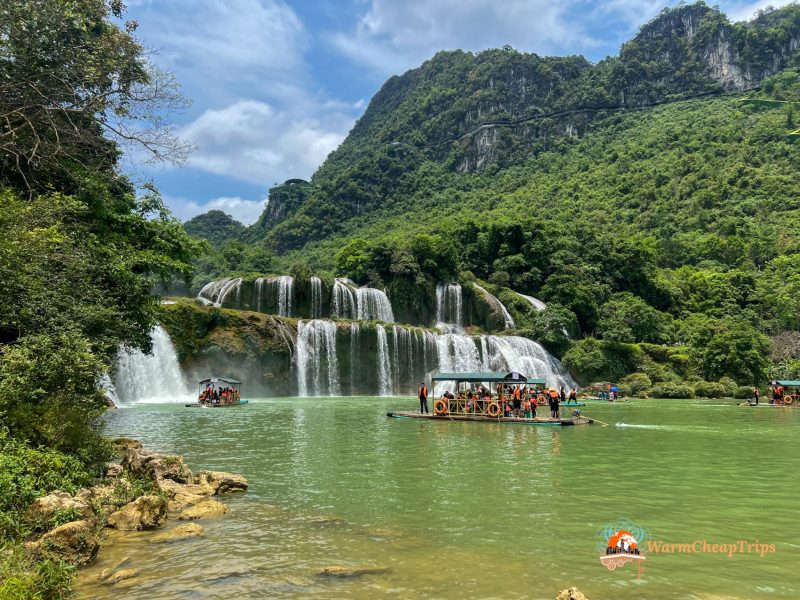
From the Vietnamese side, in addition to the main falls, you can also admire the secondary cascades. Less imposing but equally mesmerizing, the powerful water plunging through lush vegetation before gently flowing across bright green grass makes the entire scene feel almost like a fantasy world inhabited by fairies and forest spirits.
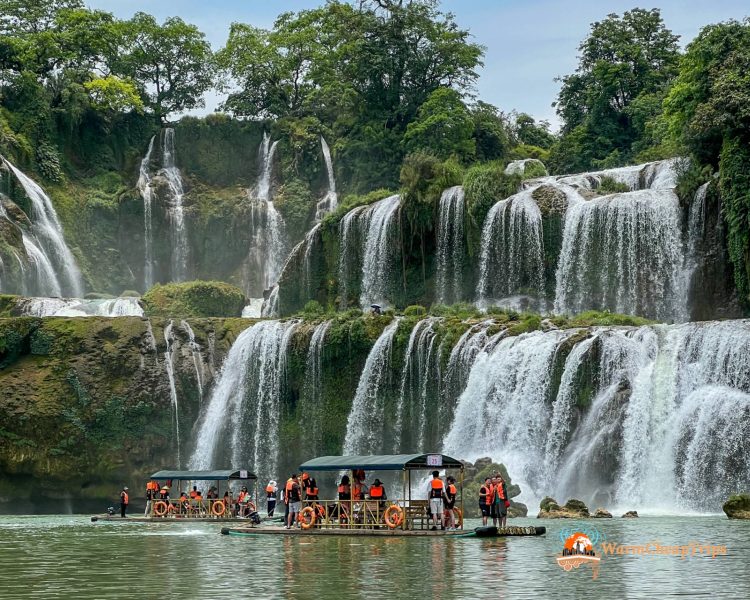
From the riverbank facing the main falls, you can take a short boat ride for 50,000 VND. The boat brings you close beneath the waterfalls before approaching the Chinese side, offering a spectacular frontal view of Ban Gioc Waterfalls before returning to the Vietnamese shore. The ride lasts only about 10 minutes but is absolutely worth it — both for the viewpoints and for the refreshing splash when you pass closest to the falls.
The best time to visit Ban Gioc Waterfalls is between May and September, when heavier rains in northern Vietnam increase the water flow. That said, when we visited in early May, there was a decent amount of water, though not as powerful as during the peak summer months.
What to see nearby
Visiting Ban Gioc Waterfalls itself takes about an hour and a half, so making the long journey from Hanoi just for the waterfalls — as we did — isn’t really worth it. There are several other attractions nearby. However, if you reach the waterfalls by public transport, you’ll have to move around on foot once there, and the Vietnamese heat can be quite challenging — as we discovered ourselves. In the end, we gave up exploring further and returned to Cao Bang, also because we needed rest after the overnight bus that had brought us there.
If you still have energy, a 15-minute walk leads to Ban Gioc Pagoda, perched on a hill and offering beautiful views over the valley and the waterfalls.
About 3 kilometers away lies Nguom Ngao Cave (also known as Tiger Cave), a natural wonder filled with stalactites and stalagmites. Since it’s relatively close, you could even walk there while enjoying the surrounding countryside. On the way to the caves, you’ll also pass through Khuoi Ky village, a Tay ethnic village that feels like an open-air museum, with traditional stone stilt houses.
How to get to Ban Gioc Waterfalls
First, you need to reach Cao Bang, about six hours from Hanoi. We arrived via overnight bus, departing at 8:30 pm and arriving around 5 am, then left the following afternoon by private van — both booked through 12Go, a platform I used frequently throughout Southeast Asia to arrange transportation. The cost was around $18 for either option.From Cao Bang, we took a local bus to the waterfalls. There was basically zero information available — we simply stood along the main road and waited for a small van marked “Cao Bang”, which eventually brought us to our destination nearly four hours later. Yes, we paid less than $1 each, but it definitely wasn’t the smartest choice!
Personally, if you plan to include Ban Gioc Waterfalls in your itinerary, I strongly recommend abandoning the idea of public transport from Cao Bang and instead renting a car with a driver or a motorbike (keeping in mind the round trip is about 180 km). This way, you can also explore the many natural highlights of this region, still far from mass tourism. A good alternative is this day tour from Cao Bang, where you can choose between riding your own motorbike (if you hold an international motorcycle license), riding with a driver, or traveling by private car, following a guide through the beautiful geopark landscape surrounding the waterfalls.
Another very smart option — and what I would personally choose if I could reorganize my itinerary — is a two-day, one-night tour from Hanoi, including air-conditioned transport, meals, and a guide. This allows you to truly relax and enjoy this lesser-known corner of Vietnam, which absolutely deserves more time. Many agencies in Hanoi offer this experience, or you can book it via GetYourGuide.
Ban Gioc Waterfalls, while undeniably beautiful, were slightly below my expectations — probably also because of the effort required to reach them. If I could go back, I would plan the visit differently, dedicating more time to the entire Cao Bang region and opting for a driver or guided tour. Because more than the waterfalls themselves, it is this remote part of the country — with its raw nature and ethnic minority villages — that truly makes this corner of Vietnam so special.
Did you find this article useful? Buy me a coffee 🙂
